Cost Optimization
33 articles tagged with "Cost Optimization"

Modern Data Stack 2026: Tools, Trends, Roadmap
Build a reliable data stack by prioritizing batch pipelines, clear ownership, and a budget before adding streaming or AI.

Introduction to Stream Processing Frameworks
Compare Flink, Kafka Streams, Spark, and Beam; test correctness, latency, recovery, and cost before choosing a streaming framework.

Provisioned Concurrency vs On-Demand: Latency Tradeoffs
Measure P95/P99 before paying for provisioned concurrency — choose on‑demand or provisioned to balance tail latency, cost, and spikes.

How AWS IoT Core Processes IoT Event Streams
Explains how IoT Core ingests, filters, and routes device events, plus guidance on scaling, replay, and reliability.

Databricks Warehouse HA: 7 Design Patterns
Seven Databricks warehouse HA patterns to meet RTO/RPO: scaling, AZ resilience, failover, retries, stateless compute, standbys, isolation.
30 Snowflake Interview Questions for Data Engineers
Core Snowflake interview topics: architecture, warehouses, recovery, loading, and security — emphasize trade-offs in cost, speed, and risk.
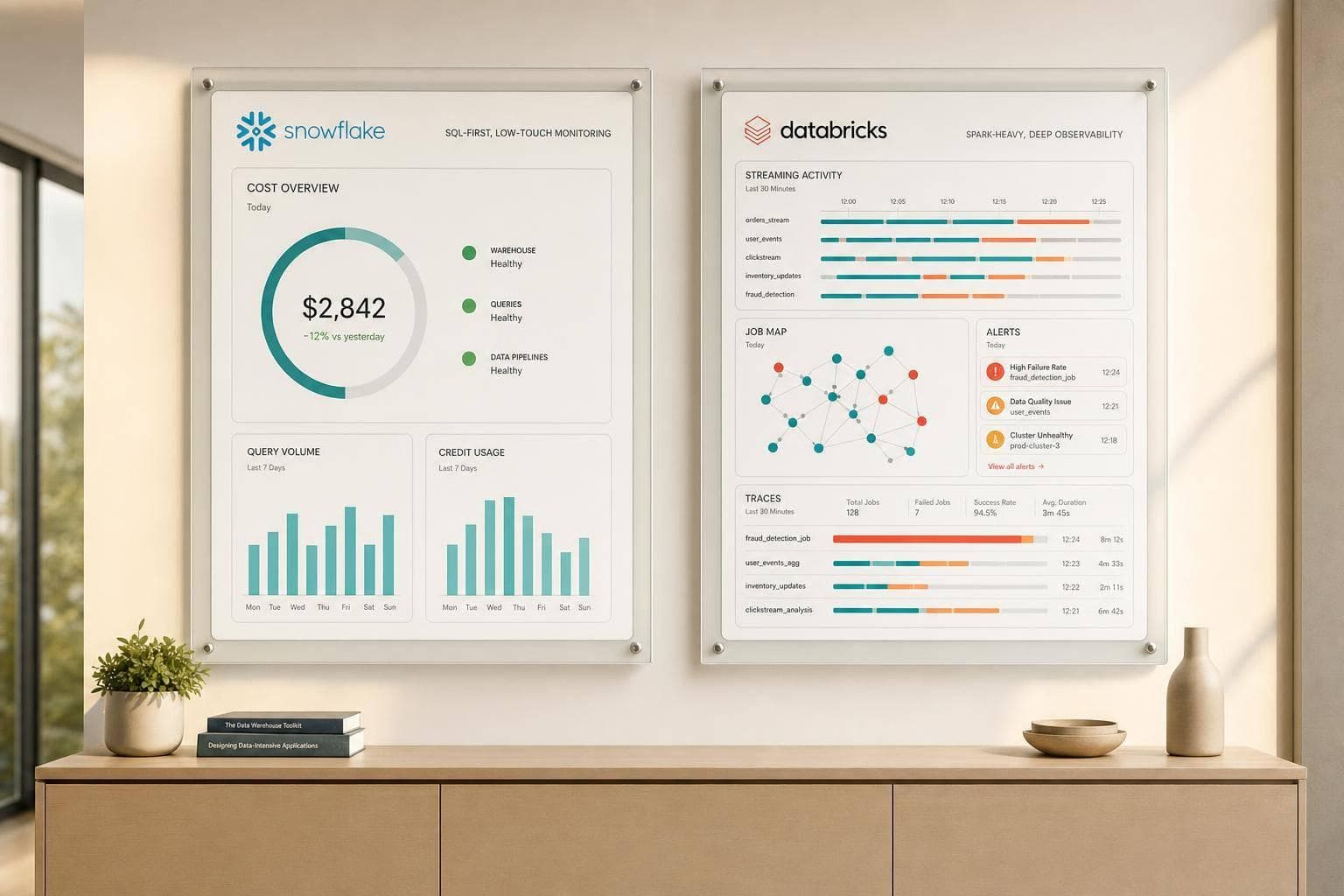
Snowflake vs. Databricks: Monitoring Features Compared
SQL-first platforms favor low-touch monitoring and credit controls, while Spark-heavy stacks demand deeper job and streaming observability.

Case Study: Caching with Databricks for Faster Analytics
Cut scans from 2.3TB to 8GB and reduce compute costs 73% using Disk Cache, Spark cache, SQL result cache and improved file layout.

Top Tools for Data Lakehouse and Data Warehouse
Choose a lakehouse for unified SQL, ML, and streaming - use open formats and governance to avoid lock-in and control costs.

Snowflake for Data Retention: Best Practices
Set Time Travel, Fail-safe, storage tiers and lifecycle policies to balance compliance, recovery, and storage cost in Snowflake.

ETL Pipeline Benchmarking: Metrics to Track
Measuring the right ETL metrics—throughput, freshness, quality, cost, and scalability—prevents silent failures and runaway cloud spend.
Snowflake Query Tuning: Best Practices for Low Latency
Practical Snowflake tuning: right-size warehouses, improve micro-partitioning, optimize SQL and caching to cut query latency.