
Data Engineer Certs and Salary: 2026 Guide
I’d choose a data engineering certification that matches your target jobs - not a promised salary boost. None of the seven credentials below guarantees higher pay. In the U.S., your role, location, experience, and production ownership matter more.
As of October 7, 2026, the listed U.S. exam prices are $150 for AWS, $200 plus tax for Google Cloud, and $165 for Microsoft Fabric. I’d confirm checkout prices and budget for practice, retakes, and renewal before registering.
Quick Comparison
| Certification | Main focus | Best role fit | Readiness |
|---|---|---|---|
| AWS Certified Data Engineer – Associate | AWS pipelines, monitoring, and troubleshooting | AWS data engineering | AWS recommends 2–3 years in data engineering or architecture, plus 1–2 years using AWS |
| Google Cloud Professional Data Engineer | Data design, BigQuery, and pipeline management | Google Cloud analytics and streaming | Google recommends 3+ years in the industry, including 1+ year using Google Cloud |
| Microsoft Certified: Fabric Data Engineer Associate | Fabric ingestion, lakehouses, and transformations | Microsoft Fabric analytics | Hands-on SQL, Spark, and Fabric practice |
| Databricks Certified Data Engineer Associate | Basic lakehouse and Spark workflows | Databricks implementation | SQL, Python, and Spark practice |
| Databricks Certified Data Engineer Professional | Production design, troubleshooting, and tuning | Databricks production ownership | Experience building and supporting production pipelines |
| Snowflake SnowPro Core | Snowflake platform basics | Snowflake loading, security, and administration | About 6 months of Snowflake production experience recommended |
| Snowflake SnowPro Advanced: Data Engineer | Complex pipelines, modeling, and tuning | Advanced Snowflake engineering | SnowPro Core required; 2+ years of hands-on experience recommended |
My approach: pick one matching credential, then build a tested pipeline with monitoring, security, and cost tracking. The badge can support hiring screens; the work supports your case for more responsibility and pay.
<u>Compare base salary and total compensation separately.</u> This guide weighs technical scope, readiness, costs, renewal, hiring fit, and salary relevance - without treating a certification as proof of production experience.
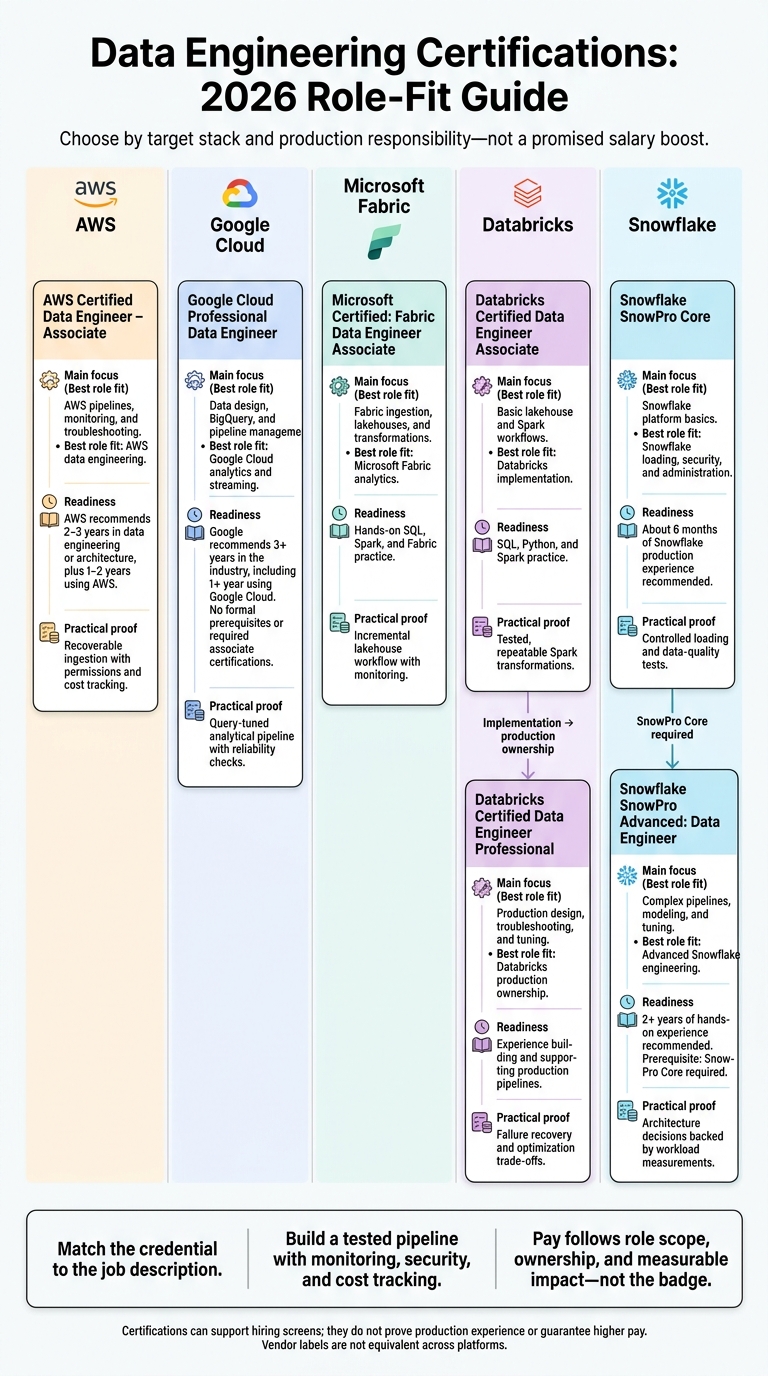
Data Engineering Certifications: 2026 Role-Fit Guide
1. AWS Certified Data Engineer – Associate
Technical scope
Study pipeline design, Spark failure modes, and when to choose Kafka, Spark Streaming, or batch Spark. For SQL, cover window functions, table scans, optimization, and data modeling. Practice applying these skills, rather than just memorizing concepts.
Prerequisites and readiness
Focus on hands-on readiness, not just eligibility. Practice data engineer interviews by focusing on SQL, data modeling, and system design under time pressure. This preparation matters most for roles built around AWS-native pipelines.
Hiring signal and role fit
The credential can help you pass screening for AWS-focused data engineering roles. But you’ll still need to explain your ingestion choices, transformation logic, and approach to failure recovery.
Let the job description guide your preparation. A streaming-heavy position needs different depth than a batch-processing role. The same goes for pay: the certification helps, but the scope of the role drives compensation.
Salary relevance
Certifications validate technical skills, but pay depends mostly on scope, ownership, and business impact. This credential is most relevant when the job already uses AWS pipelines and services.
To strengthen your salary negotiations, prioritize work that feeds automated decisions, machine learning models, or products that affect revenue. Bring measurable results to compensation discussions - not just the certification.
sbb-itb-61a6e59
2. Google Cloud Professional Data Engineer
Technical scope
For teams that rely heavily on BigQuery, this credential is the clearest Google Cloud signal. Focus on BigQuery modeling, including one big table (OBT) designs and nested STRUCT and ARRAY fields. Connect batch and streaming choices to query performance and reliability, with SQL tuning and fewer scans as priorities.
Prerequisites and credential costs
Google recommends 3+ years of industry experience, including at least 1 year designing and managing Google Cloud solutions. There are no formal prerequisites or required associate certifications. The credential stays valid for 2 years, after which you must recertify. Check current exam and renewal fees before registering.
Hiring signal and role fit
Your modeling and pipeline choices show whether you can balance cost, scale, and query speed in production. This credential fits Google Cloud–native roles focused on analytical modeling and batch or streaming pipelines. It may get you past an initial hiring screen, but you'll still need to explain and defend your trade-offs in interviews.
Salary relevance
In Google Cloud–native roles, compensation grows as you take on more ownership - from building BigQuery pipelines to guiding platform-wide design. Pay follows your level, not the badge. Some big tech roles show $150,000–$300,000 gaps between senior and staff compensation. To move up, show sound judgment: set realistic delivery targets, choose designs that scale, and turn down solutions that don't meet product needs.
3. Microsoft Certified: Fabric Data Engineer Associate
Technical scope
DP-700 focuses on Microsoft Fabric. It covers OneLake, lakehouses, warehouses, ingestion with Dataflows Gen2 and Pipelines, transformations with Spark and SQL, and environment security and monitoring. This range matters most on Microsoft-centric teams where one engineer handles ingestion, modeling, and monitoring.
Prerequisites and readiness
Prepare by building Fabric pipelines. Then check generated SQL and Spark output by running, testing, and debugging it, rather than memorizing syntax.
Hiring signal and role fit
This credential fits Microsoft Fabric roles responsible for lakehouses, warehouses, and ingestion pipelines. It signals ownership of a Microsoft-native analytics stack.
Salary relevance
For Fabric-heavy roles, treat the credential as a hiring signal - not a pay increase on its own. Markets with lower salary bands and roles with limited scope can constrain pay. Compare openings by location, ownership, and responsibilities.
4. Databricks Certified Data Engineer Associate
Technical scope and readiness
This certification is a practical starting point for entry-to-mid-level Databricks-focused roles. Focus your preparation on SQL tuning, dimensional modeling, Spark failure modes, broadcast joins, and when to use Kafka, Spark Streaming, or batch Spark. Build and test Databricks-style pipelines through labs and projects. These skills matter because Databricks teams often test your judgment about production systems - not just your exam knowledge.
Before setting your budget, check Databricks’ current exam guide for prerequisites, exam fees, preparation costs, and renewal rules.
Hiring signal and role fit
Databricks hiring favors engineers who can deliver production systems, not just write notebooks. For advanced roles, show that you’ve owned production work through revenue-facing datasets, tools with high adoption, or improvements in reliability.
Salary relevance
The associate badge rarely changes pay on its own. Role scope and ownership of production systems carry more weight than the certification itself.
5. Databricks Certified Data Engineer Professional
Technical scope
The Associate badge shows you can build Databricks pipelines. The Professional badge shows you can design and recover them at scale. Preparation centers on production design, troubleshooting, and performance tuning. Focus on Kappa architecture, advanced modeling approaches such as Data Vault, and diagnosing Spark failures and performance bottlenecks.
Prerequisites and target level
Treat this as a senior-to-staff credential, not an entry-level certification. That added depth gives it more weight in senior interviews than in entry-level screening.
Hiring signal and role fit
This credential carries the most weight at organizations that pay data engineers for senior-level ownership, particularly when their work feeds ML models or product features. It can signal stronger system-design skills and product sense.
Salary relevance
Pay follows scope and leverage - not the badge. At some top-tier tech companies, the compensation gap between Senior and Staff roles can reach $150,000–$300,000. This credential matters most when compensation reflects platform ownership and the engineer’s impact on production systems.
6. Snowflake SnowPro Core
Technical scope
SnowPro Core tests basic Snowflake knowledge across architecture, data movement, storage, protection, security, performance management, and account management. It’s Snowflake’s baseline platform credential.
Prerequisites and credential costs
Candidates should have about 6 months of Snowflake production experience before taking the exam. The supplied sources do not establish current exam, retake, or renewal fees.
Hiring signal and role fit
Core fits roles that involve loading, managing, and securing data in Snowflake. It shows platform familiarity - not advanced engineering depth.
The credential matters most on teams that rely heavily on Snowflake, especially when the job posting names it. For roles with deeper Snowflake ownership, the next certification carries more weight.
Salary relevance
The supplied evidence does not establish a SnowPro Core salary premium. Basic skills help, but they rarely change pay on their own.
The badge matters most when your role includes Snowflake ownership, cost control, governance, or pipeline reliability. For those responsibilities, the next Snowflake credential has more value.
7. Snowflake SnowPro Advanced: Data Engineer
Technical scope
This credential covers advanced Snowflake data movement, performance tuning, storage optimization, and complex modeling, including Data Vault and OBT. That depth matters when your role includes responsibility for Snowflake architecture and tuning.
Prerequisites and credential costs
SnowPro Core is required. Snowflake also recommends at least 2 years of hands-on Snowflake and dbt training. Check current exam and renewal fees directly with Snowflake before setting your budget.
These requirements make this a senior credential - not an entry-level signal.
Hiring signal and role fit
This credential suits experienced engineers who own Snowflake pipelines and tuning. For roles built around Snowflake, it shows specialization. It doesn't prove that you've owned production systems.
Salary relevance
The supplied evidence doesn't quantify a salary premium over SnowPro Core. Treat Advanced as supporting evidence for a senior role, not a guarantee of higher pay. Pay depends on ownership, reliability, and measurable impact.
The next section compares how scope, cost, and hiring signal affect pay across the certifications.
Data Engineer Salary Guide 2026 | $80K to $250K Breakdown
Comparing Skills, Costs, Hiring Signals, and Pay
Each certification serves a different purpose. The comparison below shows where each one helps most: technical depth, hiring screens, or proof of platform knowledge for a specific role.
Technical Scope: Pipelines, Lakehouses, and Warehouses
Passing an exam does not prove production skill. Use this table to compare each certification’s platform focus and the hands-on work that supports it.
| Credential | Distinguishing depth | Practical proof beyond the exam |
|---|---|---|
| AWS Certified Data Engineer – Associate | AWS pipeline design | Recovery, permissions, and cost controls |
| Google Cloud Professional Data Engineer | BigQuery-centered design choices | Measurable query improvements |
| Microsoft Certified: Fabric Data Engineer Associate | Fabric lakehouse workflows | Incremental processing and permission design |
| Databricks Certified Data Engineer Associate | Lakehouse implementation | Join behavior and repeatable transformations |
| Databricks Certified Data Engineer Professional | Production troubleshooting | Distributed-failure diagnosis and optimization |
| Snowflake SnowPro Core | Core platform knowledge | Reliable loading and access controls |
| Snowflake SnowPro Advanced: Data Engineer | Advanced Snowflake tuning | Performance under changing workloads |
Before studying, check the current exam objectives for platform services, integrations, and governance features. Similar badge names do not mean equal difficulty.
Prerequisites, Exam Fees, and Renewal
Current exam fees and renewal rules are not verified here. Check U.S. checkout prices, taxes, retake charges, and renewal costs. Budget separately for optional training and cloud practice. The table outlines preparation topics; a dash means formal prerequisites are not documented here.
| Credential | Formal prerequisites | Preparation focus |
|---|---|---|
| AWS Data Engineer – Associate | - | SQL, Python, cloud pipelines |
| Google Cloud Professional Data Engineer | None | BigQuery, modeling, system design |
| Fabric Data Engineer Associate | - | SQL, modeling, governance |
| Databricks Data Engineer Associate | - | Python, Spark |
| Databricks Data Engineer Professional | - | Distributed processing, optimization |
| SnowPro Core | - | SQL, warehouse fundamentals |
| SnowPro Advanced: Data Engineer | SnowPro Core | Advanced modeling, operational judgment |
Price matters, but matching the credential to the job matters more.
Hiring Signals: When Certifications Matter More Than Projects
Certifications carry the most weight when a job names the platform, a partner requires the badge, or a migration calls for proof of platform skills.
| Credential | Employer stack and role fit | Screening value | Supporting project evidence |
|---|---|---|---|
| AWS Data Engineer – Associate | AWS cloud data engineer | AWS-specific screening | Recoverable ingestion with permissions and cost tracking |
| Google Cloud Professional Data Engineer | Google Cloud data engineer | BigQuery-centered roles | Query-tuned analytical pipeline with reliability checks |
| Fabric Data Engineer Associate | Fabric enterprise data engineer | Fabric adoption or internal moves | Incremental lakehouse workflow with monitoring |
| Databricks Data Engineer Associate | Databricks data engineer | Basic platform familiarity | Tested, repeatable Spark transformations |
| Databricks Data Engineer Professional | Senior Databricks data engineer | Production specialization | Failure recovery and optimization trade-offs |
| SnowPro Core | Snowflake warehouse data engineer | Core platform familiarity | Controlled loading and data-quality tests |
| SnowPro Advanced: Data Engineer | Senior Snowflake engineer or architect | Advanced platform specialization | Architecture decisions backed by workload measurements |
If a posting names the platform, a certification can help you pass screening faster than a general project portfolio alone.
DataExpert.io Academy offers optional capstone-based practice through AWS, Databricks, and Snowflake labs. It is training, not a credential.
Salary Context: U.S. Role Benchmarks
The supplied material does not support a certification-specific salary premium. Compare pay by role level, location, industry, and ownership - not by badge alone. The scope you can own matters more than the badge.
Strengths and Limits of Each Certification
Scope, cost, and hiring signal help narrow your options. Next, look at what each badge actually proves.
Compare the skills behind the badge, not just its title. Associate/core credentials cover basic to intermediate implementation. Professional/Advanced credentials signal architecture, scale, optimization, governance, reliability, and trade-offs. Labels differ by vendor: Google Cloud and Databricks use Professional, Microsoft uses Associate, and Snowflake uses Advanced. A credential’s salary relevance depends on how closely its scope matches the responsibilities you’ll own.
| Credential | Strength | Limitation | Best fit | Proof |
|---|---|---|---|---|
| AWS Certified Data Engineer – Associate | Validates practical AWS data-engineering work | Does not prove deep architectural judgment or production experience | AWS-native pipeline work | Batch-and-streaming pipeline with IAM, tests, and monitoring |
| Google Cloud Professional Data Engineer | Signals advanced design and operations skills | Ecosystem-specific; does not prove production ownership | BigQuery-centered analytics engineering | Query-tuned pipeline with cost-performance documentation |
| Microsoft Certified: Fabric Data Engineer Associate | Fits Microsoft Fabric implementation | Limited signal outside Fabric; does not prove broader distributed-systems expertise | Fabric implementation and workspace operations | Orchestrated lakehouse with validation checks |
| Databricks Certified Data Engineer Associate | Provides a focused introduction to Databricks data engineering | Limited evidence of advanced optimization or production operations | Databricks implementation roles | Incremental Delta pipeline with quality checks |
| Databricks Certified Data Engineer Professional | Signals advanced development, optimization, and production work | Platform-specific; requires extensive hands-on preparation | Databricks production ownership | Tuned workload with CI/CD and observability |
| Snowflake SnowPro Core | Establishes core Snowflake administration and usage | Not a general data-engineering badge; limited evidence of advanced pipeline design | Snowflake platform operations | Warehouse with controlled loading and cost controls |
| Snowflake SnowPro Advanced: Data Engineer | Signals complex implementation and optimization skills | Employer-dependent; does not prove production-scale ownership | Advanced Snowflake engineering | Automated pipeline with tuning and recovery runbooks |
Cloud breadth and platform depth serve different needs. AWS and Google Cloud provide the clearest cloud-provider signals. Fabric is Microsoft-specific, while Databricks and Snowflake credentials cover platforms that can run across clouds.
Renewal also adds work over time. AWS credentials renew every 3 years, Google Cloud every 2 years, and Microsoft role-based certifications annually. Databricks Data Engineer Associate renews every 2 years. Check the current maintenance rules for Databricks Professional and Snowflake. More frequent renewal means more upkeep - not a stronger skills signal.
Add another badge only when it supports a new responsibility. Pairing a cloud credential with a platform credential can make sense for a role that uses both. But collecting several entry-level badges that cover similar concepts can delay work on data modeling, deployment automation, or system design.
The final section turns these trade-offs into a simple choice by role.
Conclusion: Choose a Certification That Fits Your Role
No certification drives pay on its own. Experience, system design, and ownership matter. Use the comparisons above to weigh job fit against the full cost: the exam, prep time, and renewal.
| Target role | Credential to consider | Recommended experience | Proof project |
|---|---|---|---|
| AWS pipeline engineering | AWS Certified Data Engineer – Associate | SQL and Python fundamentals before exam prep | Build backfill-safe, idempotent ingestion |
| Google Cloud analytics and streaming | Google Cloud Professional Data Engineer | Pipeline design and distributed processing | Handle late events and compare streaming trade-offs |
| Microsoft Fabric enterprise analytics | Microsoft Certified: Fabric Data Engineer Associate | SQL, modeling, and stakeholder alignment | Define governed metrics and resolve conflicting metric definitions |
| Databricks lakehouse engineering | Databricks Certified Data Engineer Associate; Professional for production ownership | Spark fundamentals; production troubleshooting before Professional | Diagnose join performance in idempotent microbatches |
| Snowflake warehouse work | Snowflake SnowPro Core; SnowPro Advanced: Data Engineer for engineering ownership | Warehouse fundamentals; complex modeling before Advanced | Implement SCD Type 2 and compare it with a One Big Table model |
A certification can help you pass screening. Practical skills show you're ready to take ownership. Focus on SQL, Python, modeling, distributed systems, production work, and design judgment. In technical interviews, a credential can't replace your ability to explain a failed Spark job, choose a data model, or defend a scaling decision.
Choose one credential that matches your target roles. Add another only when you're taking on a new responsibility, such as lakehouse architecture or real-time processing, and the added ownership, scope, and potential pay justify the cost.
FAQs
How do I measure a certification’s return on investment?
Measure a certification’s return on investment by tracking whether it helps you stand out to hiring managers, land higher-paying roles, and negotiate your compensation. You’ll get the most value when you pair it with hands-on projects that show what you know - and how you put that knowledge to work.
Look at the long-term payoff, too: Does the certification help you solve complex problems that justify senior- or staff-level pay?
How can I prove production skills without job experience?
Build and document end-to-end projects that tackle problems you’d face on the job. Go beyond tutorials: create pipelines that handle messy data and errors, record logs, and retry failed tasks automatically. Use infrastructure as code and CI/CD to show how you deploy and maintain your projects.
Your GitHub portfolio should include clear README files with measurable results, architecture diagrams, data quality checks, and orchestration. These details show you can build systems that run reliably and scale as demand grows.
Should I prioritize certification or interview prep?
Make certification a priority, not your only focus. It can help validate your skills and strengthen your position in salary negotiations. But hiring managers favor portfolios with 3–5 end-to-end, production-level projects over theoretical knowledge alone. Certifications work best when paired with hands-on experience.
DataExpert.io Academy helps you prepare for the job by combining certification prep, practical training, capstone projects, and tailored interview prep in SQL, Python, data modeling, and system design.